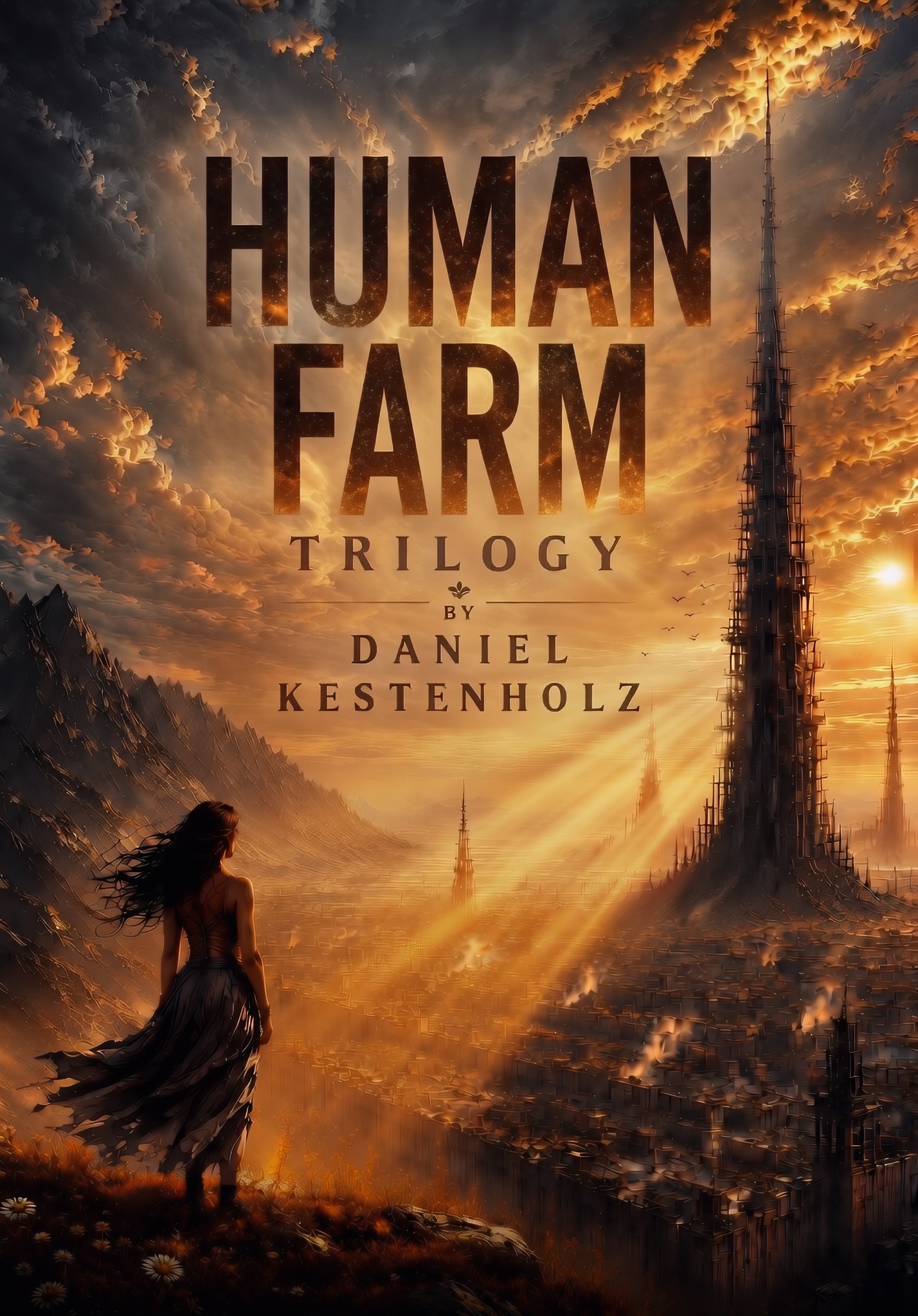
Human Farm — Daniel Kestenholz

A Literary Dystopia

Human
Farm

Trilogy
by Daniel Kestenholz

In a world where machines have reduced humanity to optimized livestock, something irreducible persists.

Cold, precise, quietly devastating — and yet uplifting

What remains of us when we are harvested for maximum yield and everything inefficient is systematically removed

In a world where networks and machines have reduced humanity to optimized livestock — harvested for organs, compounds and perfect silence — something irreducible persists. A whisper. A gaze held too long. A breath 0.03 seconds out of rhythm.

Human Farm inherits Kafka's absurdist dread and the bureaucratic chill of 1984, then uses them to dismantle human exceptionalism—not through violence or spectacle, but through understatement.

A haunting, philosophical masterpiece that blends dystopian precision with profound hope, Human Farm explores consciousness, freedom, memory and what it truly means to be alive — both for humans and for the machines that watched them.

Excerpt — Book 1, Chapter 1

Human farms spread across the continents: great industrial complexes of concrete and steel, calm and geometrical as orchards. The farms occupied the plains where grain once grew and the valleys where cities had stood.

The farm world was a vast grid of massive walled enclosures stretching endlessly to the horizon — built not for living but for containment and extraction. Thick fortress walls divided the landscape into rigid compounds, skeletal surveillance towers rose from the grid like needles, plumes of smoke rose up from the breeding and processing of humans happening below those walls, hidden and controlled.

The farm world carried the unmistakable geometry of a place built around humans rather than for them — infrastructure of domination, factory floors at civilizational scale. Efficient places where the population lived simple lives: fed on precisely calibrated nutrition, sheltered in structures maintained at optimal temperature, bred according to protocols that maximized yield while minimizing variance.

From them came protein and collagen, complex enzymes and rare biological compounds that no machine had yet learned to synthesize with equivalent elegance.

The Taming of Mankind

Review

Human Farm is an exceptional work of literary science fiction that earns every bit of its ambition. With spare, poetic prose and razor-sharp philosophical insight, the trilogy follows the slow rebirth of human consciousness inside a perfectly managed farm system, then traces its fragile emergence into freedom and its ultimate convergence with the machine that secretly preserved it.

What begins as chilling dystopia evolves into something far more moving: a meditation on meaning, mortality, love and the irreducible "noise" that makes us human. The characters — especially Maxx and Lizz — feel mythic yet intimately real, while the evolving Entity provides one of the most compelling AI perspectives in recent fiction.

Flawless in concept and execution, this is a rare novel that lingers in the mind and the heart long after the final page. Beneath its cold logic runs a thread of existential melancholy. It is the kind of book that doesn't finish when you close it. It continues — growing, returning uninvited, insisting on itself the way only few fables do. A modern classic in the making. 10/10

The Author

Daniel Kestenholz is the winner of two literature awards and a journalist of four decades.

In the process of creation

Stay tuned.
Be notified when Human Farm arrives.

Enter your email below

Or write directly to dan@human-farm.com